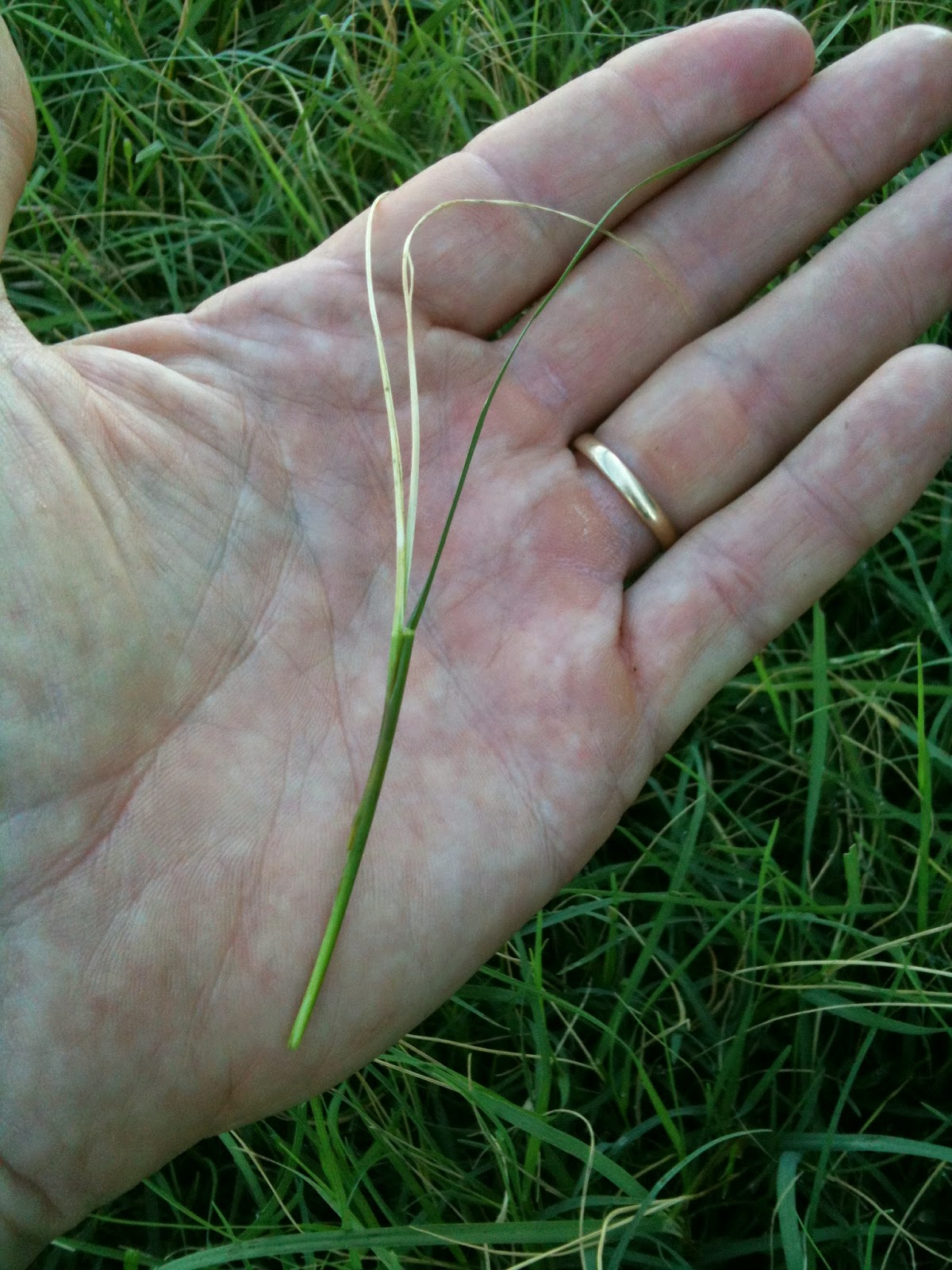
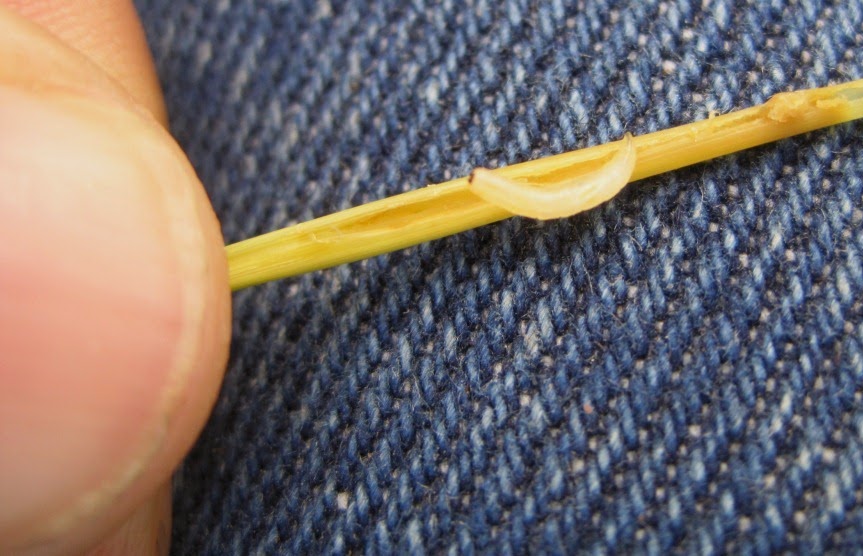
You don't imagine that a grasshopper can survive a winter but here is one! It is Sunday, February 8, 2015 on a warm, bright afternoon and out jumps this grasshopper. I was surprised that she even moved but she did more than that as I tried to catch her. I sure hope we aren't plagued again this year like we have been the last few years!
Sunday, February 8, 2015
Friday, January 30, 2015
Bermudagrass Stem Maggot
Late this past year a new forage
insect that has been slowly making its way here from Georgia invaded
bermudagrass fields in Texas. In 2010,
entomologists in Georgia found the Bermudagrass Stem Maggot in hay fields and
since that time this Central and Southeastern Asia insect has been steadily
moving west.
Dr. Vanessa Corriher-Olson,
Extension Forage Specialist at Overton in East Texas found damage in July last
year in a number of East Texas coastal bermudagrass hay fields and she
identified the insect causing the damage as the Bermudagrass Stem Maggot
(BSM). In late August I was called to
come by some fields north of De Leon to see a problem and the damage was something
I had never seen. My first call was to
Dr. Allen Knutson, Extension Entomologist and after a few email pictures he
confirmed the damage as BSM.
The adult fly of the BSM lays its
eggs on bermudagrass leaves. Once the
eggs hatch, the larva or maggot goes into the stem and begins feeding on the
leaf tissue right at the uppermost node.
As a result of the feeding the top 2-3 leaves will die as you can see in
the picture.
After the leaves die the maggot
leaves the stem and goes into the soil to pupate. After pupating for 7-10 days the adult fly
emerges to lay a new round of eggs. It is estimated that if the infestation is
severe that over 80% of the tillers in a field can be affected.
The
field that I scouted north of De Leon, Texas had between 70-80% of the tillers
dead and the hay yield was going to be
severely affected by the maggot. The
producer immediately cut the field and then a following last cutting was not
damaged.
According to Dr. Dennis Hancock,
University of Georgia Extension Forage Specialist the damage appears to begin
toward the end of the first cutting through the middle of the second
cutting. In general the damage begins to
taper off as fall weather changes begin.
I was not able to find any damaged fields by late September.
What can we do? There is not a lot we know about this insect
and certainly not a lot of control measures.
Here is a list of things that can help you manage for BSM:
- The larva causes the damage by feeding inside the stem. Since the maggot is inside the stem, conventional insecticides will not touch them.
- The adult fly does not move far, in fact they only move about 10 feet in any single flight. The flies stay deep in the canopy unless disturbed so chemical control has to penetrate the canopy to be effective.
- If you see damage and are even within 10 days of harvest then harvest! When you harvest you will remove the maggot and help lower fly numbers.
- If you do make a harvest and will have maggots again then treatment is an option. Dr. Hancock has found that you can apply an inexpensive pyrethroid insecticide like Silencer. Silencer does not have a label for BSM but it is labeled for most insects in bermudagrass including armyworm and grasshoppers. Apply a pyrethroid when the grass is growing 7-10 days after harvest and then again 7-10 days later. The cost of the two treatments is easily justified by the forage yield saved!
- · Alicia, Coastal and Tifton 44 are the most susceptible since they are finer textured bermudagrasses. Tifton 85, which is a coarser grass, has shown to have fewer tillers damaged and so less yield loss.
Thursday, January 29, 2015
Texas Wintergrass
This grass has good nutritional qualities now but as it matures it loses quality. Fortunately we have other newly emerged plants in early spring that take up the slack.
One problem with this grass has been the invasion of this grass into bermudagrass hayfields. The drought has caused much of this and producers are scrambling to get rid of it. Our only options are chemical controls in the winter.
Wednesday, January 28, 2015
Rust in Wheat
I was looking at a wheat field today and was surprised how yellow it was. Looking closer I found lots of rust on the older leaves.
As you can see in the picture the rust is quite prevelant and damaging. There is really nothing to do now but keep watch. I saw that the new growth is good and not infected. The warm weather is helping tremendously now. We won't think about spraying until flag leaf. For now we monitor.
Monday, January 26, 2015
Agriculture in Copan
January 19-26, my daughter Kate and I traveled to Copan Ruinas, Honduras to visit agriculture projects and teach. We are working as a part of Baptist Rural Life Ministries and have been for 10 years. We visited Chorti communities and toured fields to first see what some of the problems were and then we finished the week with training.
There are three major crops we are concentrating on; corn, coffee and cacao. The Chorti mainly grow corn but as world coffee prices have increased they have steadily grown more and more coffee.
Cacao, or as we know it, chocolate, is from the Americas but over the years has been replaced by other crops and the original knowledge about growing cocoa is gone. Africa is the world's largest producer now but Honduras has potential to grow and export cacao too.
We are showing the Chorti how to grow cacao, varieties to plant, when to harvest and ferment cacoa and how to process seeds to sell. We have no plans to develop actual chocolate products but some individuals might!
Right now Honduras is seeing a lot of land planted to Arabica coffees. Arabica is the highest quality coffee type and so brings the highest prices. Honduras grows only Arabica types and is know for producing superior coffees. We visit and work in the Copan area which is know for growing some of the best shade grown coffees in the world.
Unfortunately the typical coffee varieties grown in Honduras are very susceptible to the disease, "La Roya." This is a rust type of fungus which kills the leaves, defoliates the plant and eventually kills it. In the picture you can see a coffee plant devastated by La Roya next to Kate. This plant will die and be replaced by another.
Part of our work in Honduras with the Chorti is to teach them how to grow and process superior coffees and sell them for higher prices. In that we are evaluating disease resistant coffee trees with the hope that in the future our farmers won't be wiped out by diseases. We are reaching out to World Coffee Research at Texas A&M and to IHCAFE, the Honduran Coffee Growers Association.
It is our hope to be able to introduce new varieties while we improve their production practices. Still a long way to go!
Subscribe to:
Posts (Atom)